Since the initial few years after my diagnosis my state had been quite constant.
Around the time of my last consultant appointment in 2013 I had a young baby and my MS was in a good state. It was difficult to keep getting myself and a colicky baby into Oxford.So, my consultant decided that unless my condition changed there was no reason to have yearly check-ups.
However, in 2020 my MS began to turn. My legs felt heavy, my balance became worse and I had more pronounced drop foot than I’d had before.
Walking had become very difficult, tiring and, due to having falls, dangerous.
I reluctantly bought a rollator as that seemed like the only way I could get about safely.
After a particularly problematic walk I decided to contact my MS nurse.
After describing my symptoms and how they had made my life so difficult and miserable he explained that it sounded like I was experiencing spasticity.
Spasticity tends to affect between 40% – 80% of people with MS at various points in their life.
It describes the muscle spasms/stiffness which, for me affects the legs but can affect any part of the body.
Spasticity happens when damage occurs to the nerve pathways which connect your brain, spinal cord and muscles.
Usually, the muscles can work smoothly but, when damaged, the limb can feel stiff and tight, making them difficult to move.
I was prescribed a muscle relaxant called Baclofen. Although it is far from a miracle cure, I do find walking and sleeping easier now that I regularly take this medication.
I also began using foot splints. These fit onto my feet and lower legs.
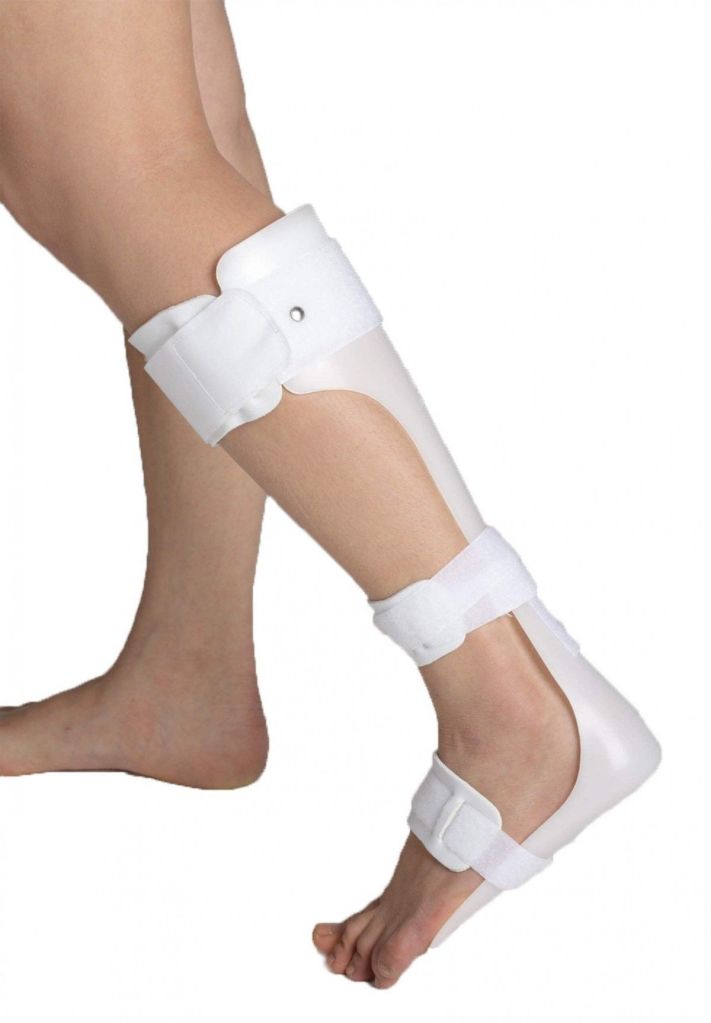
As helpful as they are with reducing the foot drop they have been problematic with driving and clothing! I can drive with them on but it is like wearing large boots! I have also had to adapt my clothing when wearing these splints. They do not work with skinny jeans!
So fast forward two years to January 2022 and I had my first consultant meeting in 13 years.
After the meeting I received some rather devasting news. My multiple sclerosis has progressed into the secondary progressive stage.
Of course, this diagnosis is dependant on the MRI which I will very soon be having. Hopefully the scan will show that the lesions in my brain have not increased to such a level of Secondary Progressive but I will report back.
A positive about the meeting though was how much treatment has increased over the 13 years.
We discussed whether I could begin disease modifying drugs.
Siponimod is a newly registered daily tablet which can delay the progression of secondary progressive MS. It is the first new treatment for this stage of MS in 10 years.
To help with the condition of my legs my consultant also suggested botulism injections.
These are injections of Botox which helps minimize the tightening of the muscles and helps produce normal nerve communication as a result. This is a fairly short term (lasting 3/4 months at a time) but it is an exciting development.
After going through this first step in my new journey of MS I am feeling different emotions.
Firstly, I am feeling hopeful from all the new treatments which have been developed in MS.
I have gone from feeling sad that my condition has progressed to a much more disabilitating state to feeling positive that this may not be my forever.
I am also feeling very regretful that I had somewhat slipped through the net of ongoing MS care.
Perhaps I could have been taking disease modifying treatments while I was in the relapsing remitting stage of the illness? Perhaps my own self care when it came to diet, exercise and stress reduction could have been better?
However, I have now ensured that professional medical care is aware of me (!) and that my new type of MS can be treated.
The next step of my treatment is to have an MRI scan of my spine and brain. I had an MRI scan in 2009, previous to diagnosis and I just remember it being very noisy!
I will report back on this and how the results of the scan fare. I am nervous about what the results will show but mainly glad that I am now back in the net!
 The Kids, Me and MS